I love listening to audiobooks. Even on the 2-credits-a-month plan, I'm still counting down the days until they refill.
Now, here's the annoying part… when people ask me what they should listen to next, outside of my top like 4, my mind goes blank.
Not because I haven't listened to anything — I've been through hundreds of audiobooks, and I have real opinions about most of them. But those thoughts and opinions live somewhere I can't always reach on demand. I'll remember that I liked a series, but not why, or how much, or whether the narrator was the whole reason.
Past me had all the information about an audiobook, game, or movie… And wrote none of it down.
It got more real when my 12-year-old started listening to books. He wants recommendations, and I want to hand them over — but I genuinely can't remember whether a given book had language in it, or themes he's not ready for. I read it. I knew this. Past me had all the information and wrote none of it down.
And on top of all that: I just like making ranked lists. Tier lists, top tens, “okay but where does it actually sit” arguments with myself. Comparison is one of my favorite ways to hold an opinion.
So the idea was simple. A diary of everything I've consumed — books, shows, music, movies — ranked, with my own notes attached. Not a review site. Not stars for strangers. Notes from me, to future me, so that when somebody asks, I have an answer.
Ranking Shouldn't Feel Like Homework
A few things were clear from the start.
I didn't want to assign scores out of ten. That's homework, and it pushes aside anything that doesn't make the top 10. The thing that actually works is comparison: do you like this more, or less, than that? Answer a few of those and the new thing settles into place on its own. (The app Beli does this for restaurants, and it's honestly fun entering data into it. I'm always downloading apps just to test how they handle certain interactions, and that rating flow was the seed for this.)
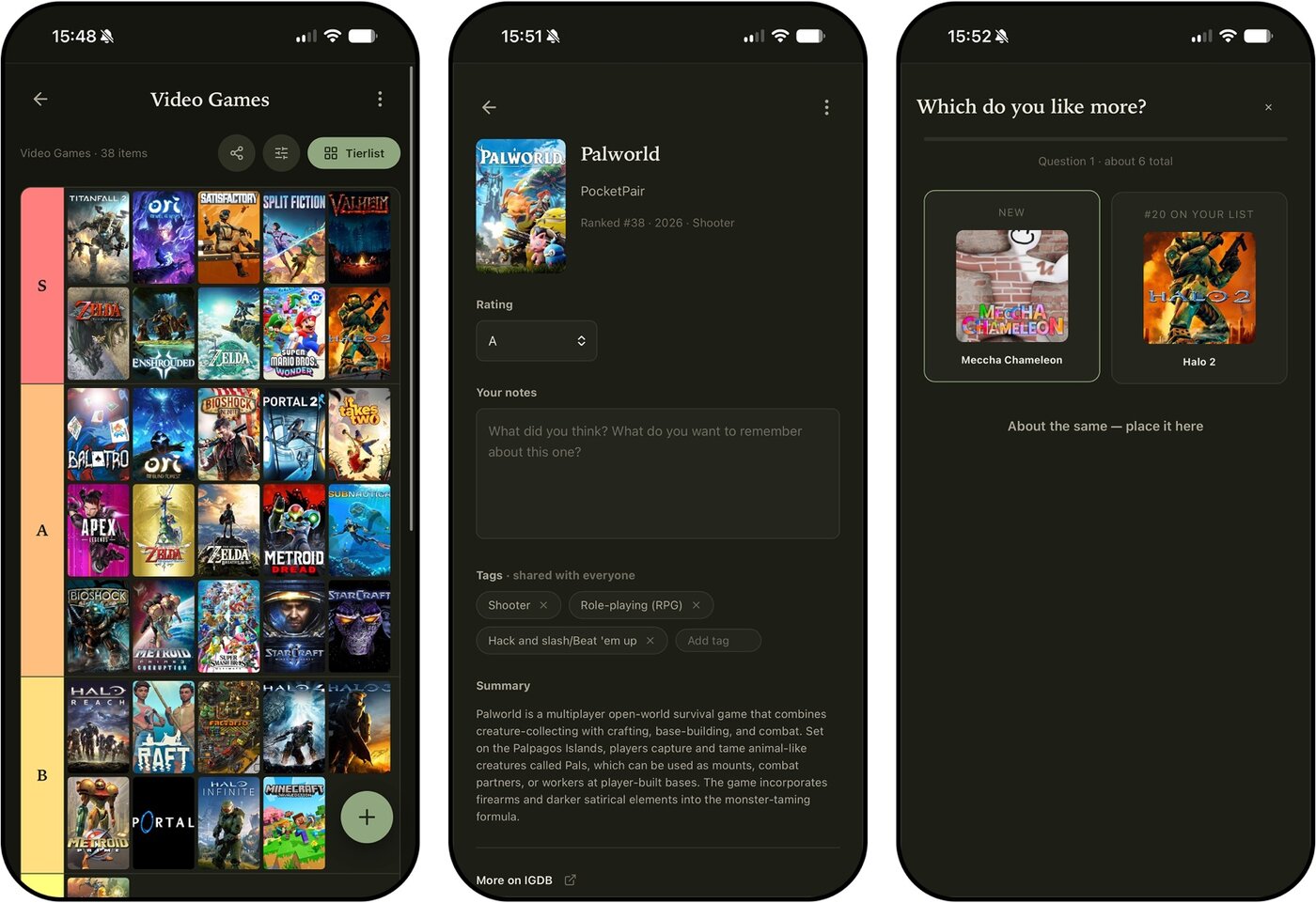
Second: the notes and rankings had to be front and center. The rank tells you where something landed within the list; the note tells you why — and the why is the part that evaporates over time. “Great world-building, dragged in the middle, clean content, fine for the kids” is worth more to me in two years than any “9/10” number.
And third, it had to handle everything I consume. Not just books. All of it.
Start Small, Then Keep Pulling the Thread
Make the thing exist, then make it pretty.
I started with one media type — audiobooks — and data saved right in the browser. I built just enough of the app to answer one question: is the comparison-ranking flow actually fun with my own library in it?
It was! That's the checkpoint that made everything after worth doing.
From there it grew in stages, and every stage had the same shape: this is what I wanted, this is what I built, here's what that unlocked. A real backend, so my lists follow me between devices. An installable web app, so it lives on my phone's home screen like anything else. And then media types, one at a time — which is where most of the real engineering lived, because every type needs somewhere to pull titles, covers, and details from, and there is no single place that has all of it. Each one turned into its own little research project. Some have official APIs. Some have great community-run sources. And a couple took genuinely creative plumbing that I'm not going into here — partly because it's my secret sauce, partly because it feels like the kind of thing that gets patched the moment you brag about it.
My favorite of those stories is hiking trails. (Yes, trails made it in — turns out “things I want to remember my opinion about” doesn't stop at media.) There is basically no public API for trail data anymore; the big trail apps are closed ecosystems. The answer ended up being OpenStreetMap — the community-built map of the world — which is free, open, and way deeper than I expected. As a bonus, trails without cover art get a little tile drawn from the actual shape of the route. One of my favorite small details in the whole app.
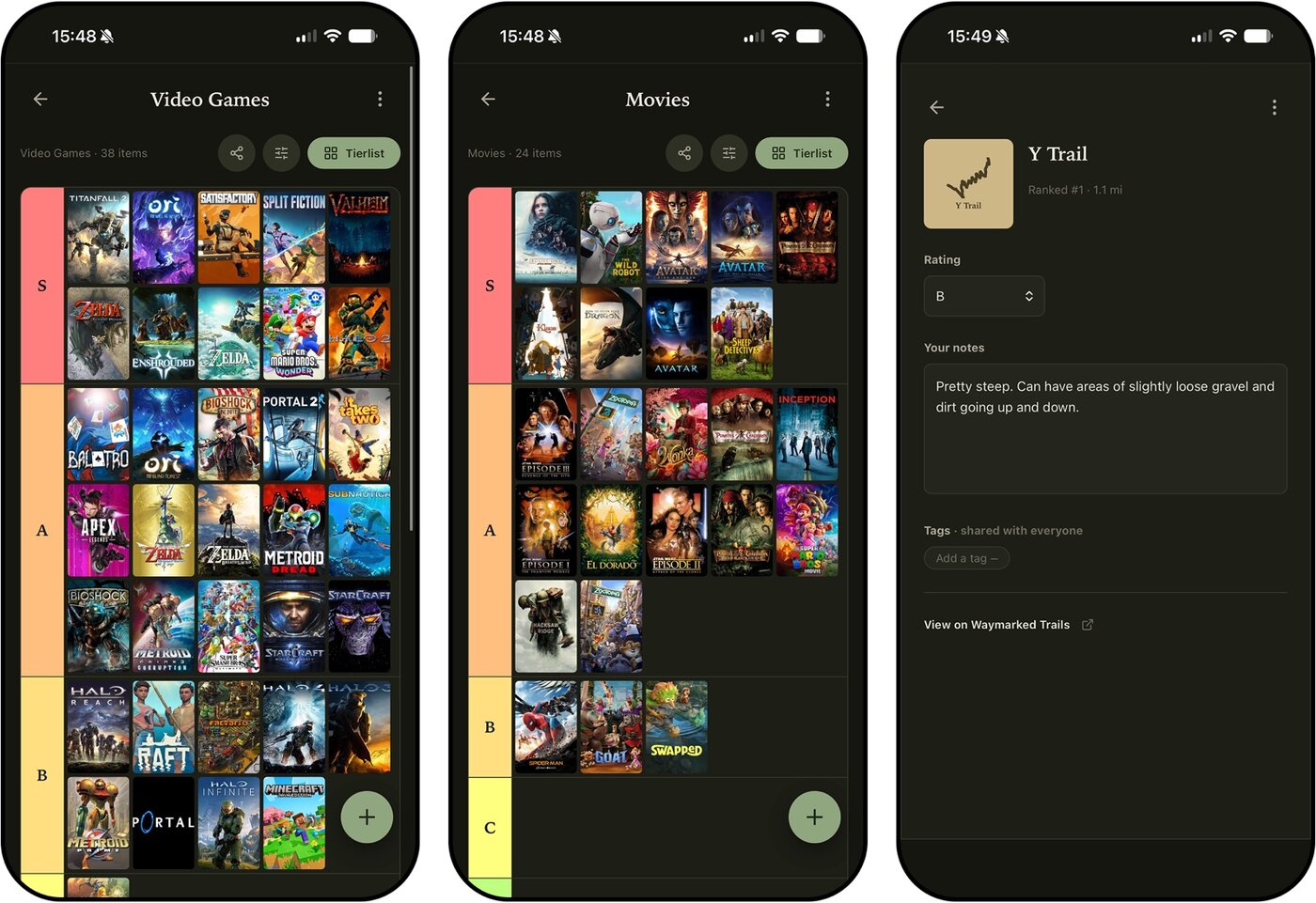
Somewhere in there it stopped being a prototype and became the app I reach for every day when I have a few minutes, or remember something to add to the list. Nine categories now: audiobooks, books, music, movies, TV and anime, video games, board games, restaurants, and trails. And the newest layer I am working on now is sharing — public links for any list you choose to publish, with real preview cards (similar to Spotify share cards) when you drop one into a text. Because rankings are more fun as a conversation. Everything stays private by default; sharing is for when you want to start an argument about your tier board on purpose.
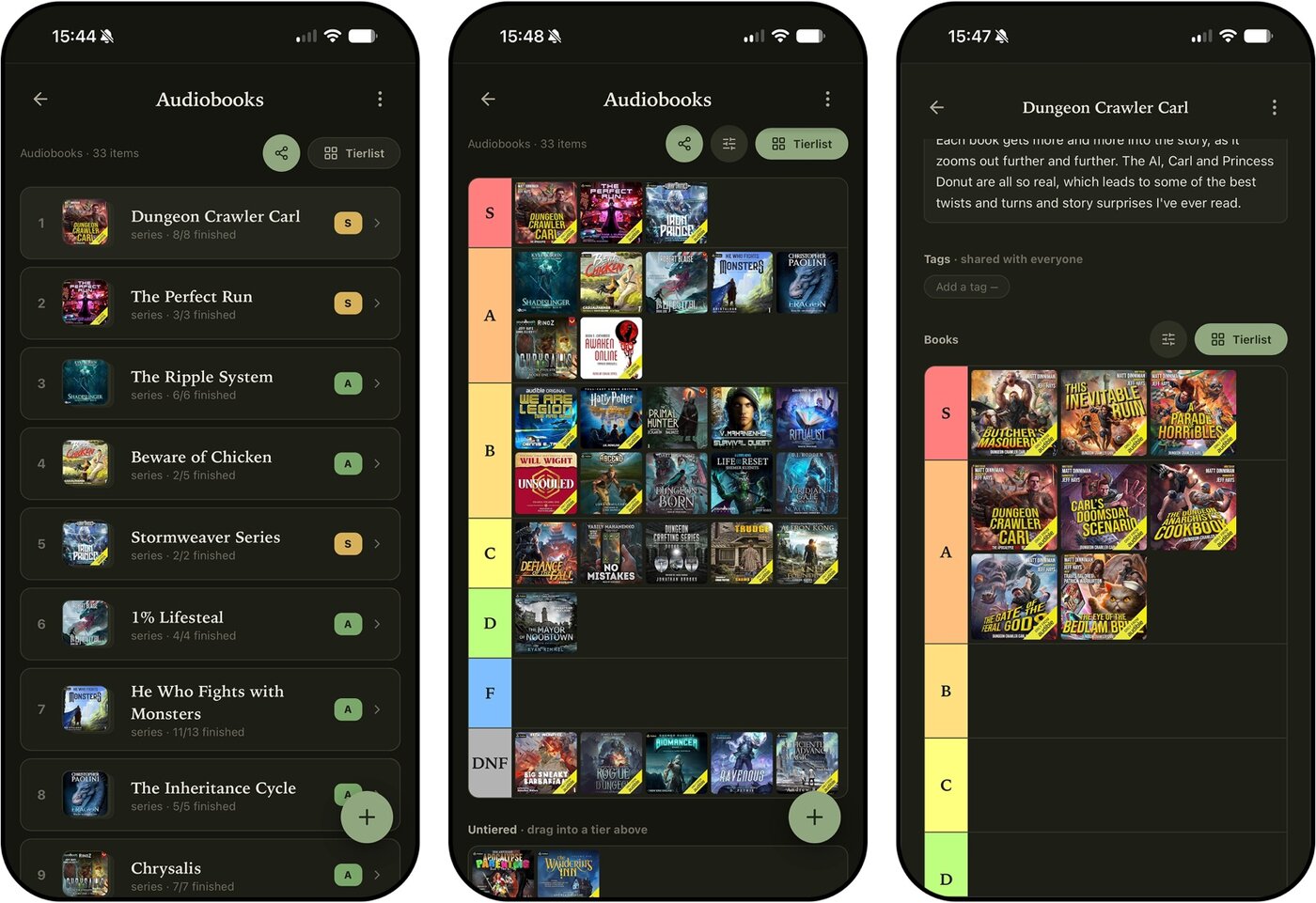
One of the big things that sets this app apart from other ranking lists is that it, by design, doesn't just want your top 10. It wants everything you're willing to put into it — so you can see your whole history, spot trends, and compare full lists with others. Every list also gets a tier-board view, so you can see everything you liked and didn't at a glance — and then dig into each item and rank what's inside it. (Rate your favorite music artists. Then go in and rank each album and song against each other…)
I built all of this with Claude Code as a pair — me driving the design and product calls, Claude doing a ton of the implementation under that direction. If you read my last article, you know I have moved a lot of my product design process into the dev environment, and this app is a long-running example of it. That process probably deserves an article of its own.
The Name (This Is the Part I Actually Want to Tell You About!)
For most of the build, the app was called RankList. On the nose, does what it says. I never loved it, and when I finally searched around — of course. Other people are building rank-your-stuff apps, and the name was thoroughly taken. Honestly? A relief. It gave me permission to find something better.
I tried the deliberate route first. Word lists, mashups, “Lore” (which I liked — this whole thing is basically personal lore), then “Ranklore” as the sensible compound. Sensible was the problem. It checked every box and sparked… nothing. I sat with it for a week hoping it would grow on me. It didn't.
So I changed tactics. Forget describing the app — what are words I've just always loved? Monolith. Forge. Vault. Words I'd doodle in a notebook because I like how they sound, and the emotions they evoke. And somewhere down that list, a much older memory surfaced.
A long time ago I played Myth II: Soulblighter, and in the lore of those games there's an artifact called the Tain — a small object you could hold in your hand, with an entire pocket dimension folded inside it. It was forged as a prison: an ancient hero used it to trap a race of monsters, and whole missions in the game take place inside it. A little thing containing a whole world. That name has been stuck in my head for twenty-five years — one of those words that just sounds like what it is.
When it resurfaced, I looked it up. And this is where it got a little eerie.
-tain is a real root, from Latin through French, meaning “to hold.” It's the engine inside attain, obtain, contain, maintain, retain, entertain. Holding is literally what this app is for. It contains my lists. It retains what I thought. About the things that entertain me. The word I'd loved for decades for its sound turned out to mean the thing I'd spent months building.
One more layer, because the universe was apparently showing off: in French, tain is the word for the silvered backing of a mirror, the invisible layer behind the glass that makes reflection possible. I could not have coined a better word if I'd tried. (And I had tried. For weeks!)
So: Tain. A small thing that holds worlds — that makes reflection possible.
What's Next
The logo and login screen are next — I'm leaning into the word itself, dictionary-entry style, because a name this loaded should get to explain itself. After that: letting people pull items from a shared list straight into their own, and a few more ideas I'm sitting on.
I also have been building this using a quick-and-dirty design system that I made at the start of the project. The reason: I wanted to focus on making this exist first, after which I would work on making it pretty. The design system was the main time-saving thing I did at the start, so that when it comes time to ‘hit it with the pretty stick’ it can do it all at once across the entire app. I'm focused on getting the UX right first — then I'll update the UI and polish the interactions, which still aren't quite where I want them.
So here's my pitch this time: whatever it is you keep meaning to remember — books, movies, restaurants, anything — start writing down what you actually thought. Future you is going to get asked. And if you're the kind of person who likes to debate about which movie is better, or what you liked about them later on, or who just wants to keep a record of what content you have consumed, this is being built for you too.
More soon.