The two ways people leave.
Two failure modes, and only one of them is visible.
The first is switching. It works — but every switch costs a first session. You restart your history with someone new, and the intake burns the hour you came for. That came up constantly in research as the biggest complaint about changing providers.
The second is the one I wanted to solve: people who just ghost. They’re the majority, and the product never hears from them. The question isn’t “why did they leave?” It’s why didn’t they rebook?
Eleven directions, then two.
I started in Whimsical with sketches and wireframes — about eleven directions for where an intervention could live. I compared all of them against the same four questions: when do you ask, what do you ask for, how is it framed, and who starts it.
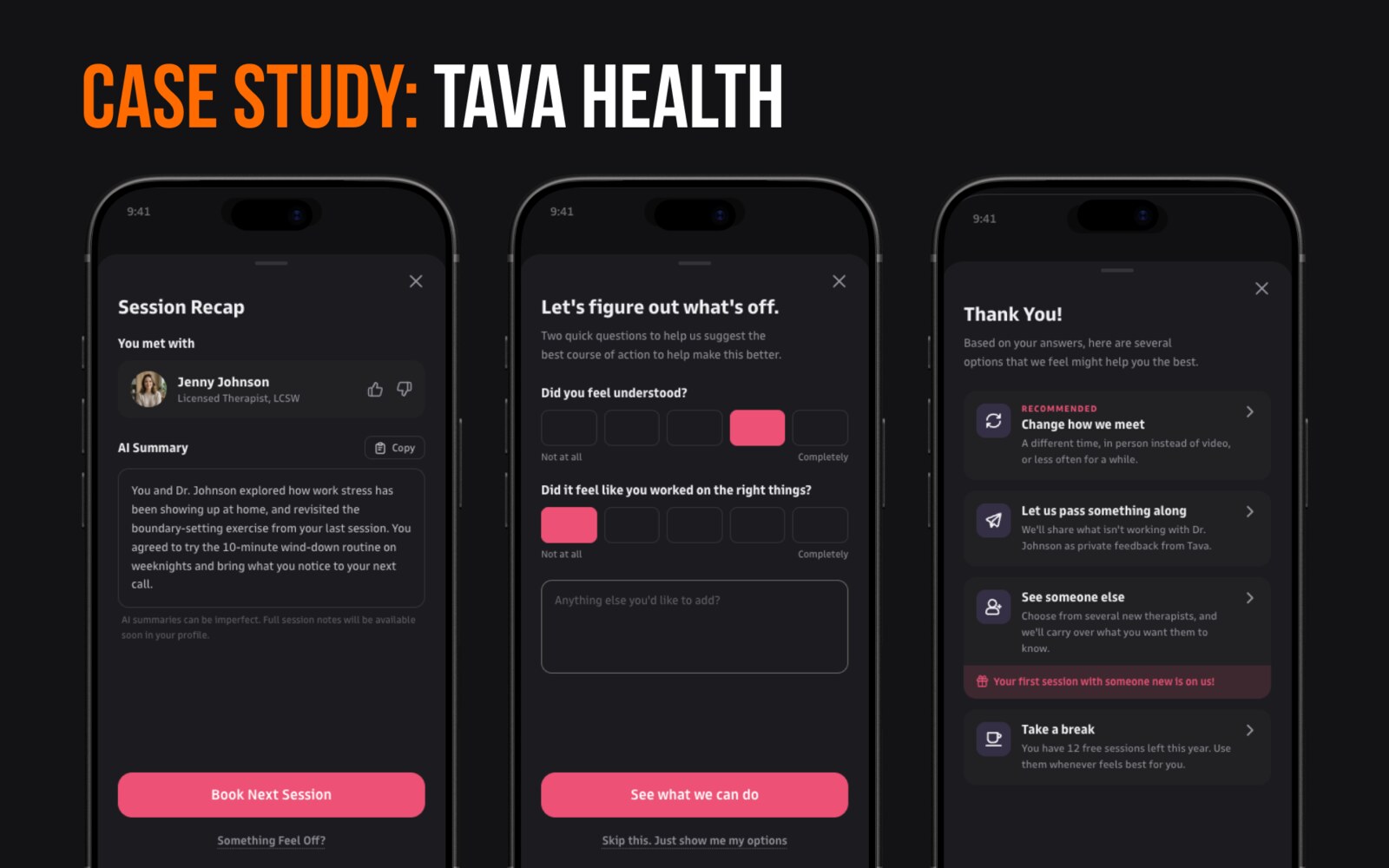
Two survived. A concierge chat, where a person or an AI sits between you and the problem and surfaces prebuilt cards — here’s a fix, here are people you could try, here are open times. And a post-session check-in, which is simpler and lands while the feeling is still fresh.
I flowcharted both and compared them side by side. The check-in ran bigger as a flow, and it’s the one I picked.
The part I’m proud of.
Most of the time, leaving isn’t about the therapist being wrong. It’s about one thing that never got said.
So the check-in offers to say it for you. “What would you like them to know?” — a few starter prompts, or write your own. Then, before anything sends: “Here’s exactly what we’ll send.” You see the message, you can edit it, you can back out.
And if you do want someone new.
The switch path attacks the thing that makes switching expensive: starting over. You pick from a short list of providers, then choose what goes with you — past notes, AI summaries, assessments. Your next therapist starts already knowing something about you, so session one isn’t spent rehashing. Then date, time, summary, and it’s on your calendar.
Motion, because it’s the whole question.
Calm, functional motion — no celebration. Nothing cheers when you tell your therapist something isn’t working. Whether a flow like this feels gentle or clinical can’t be answered in a static frame, so every transition is a replayable study in the prototype above.